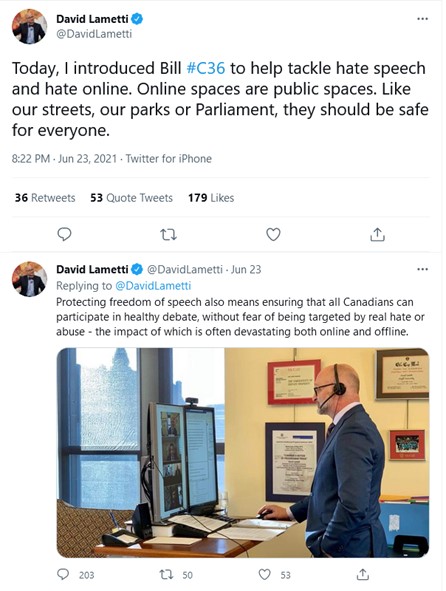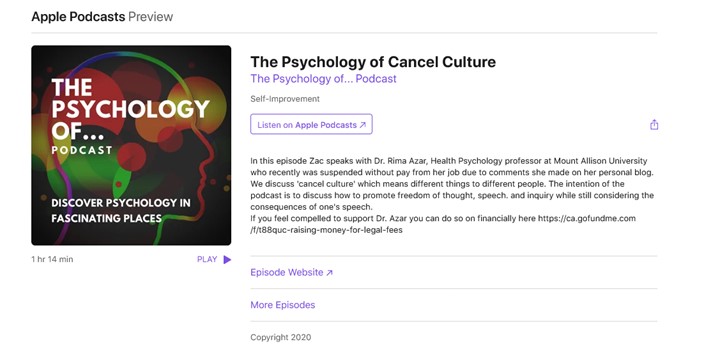
Recently, Dr. Lametti introduced Bill 36. He tried to convince us in the media that this is meant to “tackle hate speech” (https://globalnews.ca/video/7976115/canada-announces-multi-faceted-approach-to-combat-online-hate-speech-crime-with-bill-c-36).
What is “hate” to begin with, Dr. Lametti?
Who will define or identify it?
And why do you think we need such a bill?
Thank you for your hard work… but, NO, to your Bill 36.
This bill is not just a slippery slope toward a government-sanctioned form of censorship.
This bill is the evidence of it.
Sadly, Bill 36 was introduced by a party called “Liberal” for which Bambi has voted most of her Canadian voting life.
With all due respect, Bambi finds this bill to be illiberal.
She strongly opposes it.
Mind you, she would have opposed it, regardless of the political party introducing it.
Yes, sorry Dr. Lametti/Mr Trudeau, but Mr. Levant seems to be right about it and how we went from Bill 10 to Bill 36: https://www.rebelnews.com/justin_trudeau_introduces_worst_censorship_law_of_any_western_democracy .
According to Global News (https://globalnews.ca/news/7976076/bill-c-36-online-hate-canada/), “the bill would amend the Canadian Human Rights Act to make it a “discriminatory practice” to communicate hate speech through the internet where it is “likely to foment detestation or vilification of an individual or group of individuals on the basis of a prohibited ground of discrimination.”
Clearly, this bill can target citizens like Bambi who express their opinions about this or that topic.
In the case of Bambi’s blog, a person or a group may claim they felt offended, emotionally triggered, or specifically “hated” while reading this or that post.
Some of us may have a thin skin… others bad faith. Yet others may truly feel like they are being hated.
According to Bill 36, her blog would communicate so-called “hate speech” that can in the future be considered as “a discriminatory practice” (https://globalnews.ca/news/7976076/bill-c-36-online-hate-canada/). Since when do we discriminate against anyone by sharing our thoughts?
Similarly, Bill 36 can/will sadly be used against Bambi’s fellow citizens.
This makes Bambi think of “You are next”, to borrow the brilliant title of Dr. Jordan Person’s interview.
The next person may be you… or Mr. Levant or his guest, called Mr. Spencer Fernando (in the link above), whether you agree with their opinions or not, whether you like OR “hate” them, online or in real life.
Instead of leaving alone citizens who think differently on this or that issue, we are proposing a bill that can fine them… and silence them.
Is this fair?
With such bill, will Canada remain democratic in the very long-term?
Plus, we are no longer talking here about our own beautiful criminal laws or violations of our Charter.
We are not just condemning violence or defamation, as per our laws… We are rather promoting censorship.
We are doing it by using (or claiming to use) feelings. As Mr. Levant explained it well, who has not loved or hated someone or something in his life at one point or at another?
Stated differently, this bill has the potential of being highly arbitrary and has the power to censor Canadians.
Bambi does not support it, even if it is presented to her as an appealing candy called “anti-hate”.
Is this the kind of Canada you want to live in in 2, 5, 10, or 25 years if this bill or similar ones become laws?
This is surely not where Bambi would like to see Canada in 5, 10, and 25 years from now.
With all due respect to these beautiful places, Bambi does not want Canada to resemble Qatar, Dubai, Singapore… or China.
Yes, the above are all authoritarian places. So why are we modelling them?
To conclude this post, Bambi urges you to re-consider Bill 36, Dr. Lametti/Mr. Trudeau.
It is also her hope that our lawmakers, from the other parties and the independent voices (i.e. Ms. Jody Wilson-Raybould) will have enough lucidity and courage to say no to this bill, if they also see what Bambi is seeing.
Thank you.